










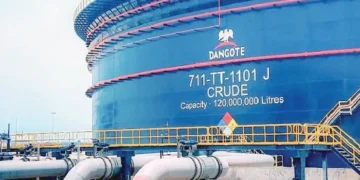





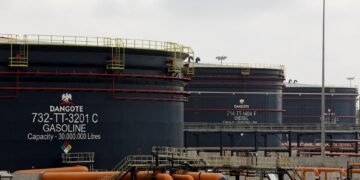















The Dangote Petroleum Refinery & Petrochemicals has processed crude oil at 700,000 barrels per day during an independently verified performance test, exceeding its nameplate capacity by 50,000 barrels.
The result, confirmed by third-party process licensors, marks a notable operational threshold for the sprawling Lekki Free Zone complex and sets the stage for a more ambitious expansion that company executives say could redefine global refining by 2028.
Devakumar Edwin, Vice President for Oil and Gas at Dangote Industries, described this as a waypoint rather than a destination.
The company is targeting 1.4 million barrels per day within 30 months through the addition of a second unit of comparable scale.
If achieved, the complex would surpass South Korea’s Ulsan facility and Saudi Aramco’s Ras Tanura which will make it overall biggest.
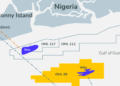
The 2,635-hectare site outside Lagos was built to address one of Nigeria’s most persistent economic contradictions: the country is among Africa’s top crude producers, yet has spent decades importing billions of dollars worth of refined petroleum products.
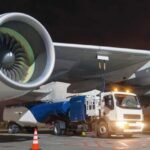
Since commencing fuel production in 2024, the refinery has expanded its buyer network well beyond Nigeria’s borders. Refined products including petrol, diesel, and aviation fuel — now reach markets across Africa and Europe, with gasoline supplied to the United States and jet fuel to Saudi Arabia.
In April 2026, S&P Global Commodities identified Dangote Petroleum as the world’s largest exporter of jet fuel for the month, a position it secured partly by filling supply gaps created by disruptions in the Middle East.
The naira has historically borne the cost of that dependency, and sustained domestic supply could provide meaningful relief.
Still, observers caution that infrastructure constraints — ageing pipelines and last-mile logistics gaps — remain a bottleneck between the refinery’s output and the country’s fuel consumers.
Realising the full economic dividend, they argue, will require parallel investment in downstream distribution.
The company also plans to move into higher-margin derivatives, including liquefied petroleum gas, polypropylene for packaging, and Linear Alkylbenzene for detergents, which would broaden its revenue base beyond fuels.
The push toward 1.4 million barrels per day arrives amid divergent forecasts for global oil demand.

Administrator and Writer