

















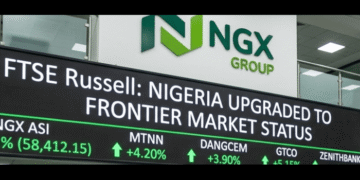





















Nigeria’s capital market is preparing to adopt a T+1 settlement cycle effective Friday, May 29, 2026.
This reduces the time between trade execution and the final settlement of securities and funds from the current two business days (T+2) to just one business day after the trade date (T+1).
The announcement, issued on March 16, 2026, is a progression in post-trade infrastructure reforms.
This follows the successful transition from T+3 to T+2 settlement on November 28, 2025.
Understanding Settlement Cycles
The settlement cycle refers to the time between the trade execution date (T) and the final transfer of securities and cash between the buyer and seller.
– T+3 is the former standard: Settlement occurred three business days after the trade.
– T+2 current, since late 2025: Settlement in two business days.
-T+1 upcoming): Settlement in just one business day.
Under the new regime, trades executed on or after May 29, 2026, will settle one business day later. To ensure a smooth handover:
Why This Matters: Key Benefits
Reduce settlement and counterparty risks — Less time between trade and settlement lowers the chance of defaults or failures.
Boost liquidity — Faster access to funds allows capital to recycle more quickly, enabling investors to redeploy proceeds sooner.
Enhance operational efficiency — Brokers, custodians, registrars, settlement banks, and institutional players (including pension funds and asset managers) will benefit from streamlined processes.
Align with global standards — Many leading markets, including the United States which moved to T+1 in 2024, operate on T+1 or even faster cycles. Nigeria’s step positions it closer to international best practices, potentially attracting more foreign portfolio investment.
Drivers Behind the Shift
The move is driven by the Securities and Exchange Commission (SEC) and CSCS, Nigeria’s central securities depository, to achieve several key objectives.
CSCS explains that the market will transition to a T+1 settlement cycle from May 29, 2026, meaning that all securities transactions will now be completed one business day after the trade date instead of the current two days.”
“Trades executed on Thursday, May 28, 2026, which will be the last trading day under the existing T+2 settlement framework, and transactions executed on Friday, May 29, the first day of T+1 trading, will both settle on Monday, June 1, 2026.”
CSCS has positioned the transition as part of broader modernization under the Investments and Securities Act and ongoing reforms.
Preparation and Next Steps
Success depends on readiness across the ecosystem. Exchanges, brokers, custodians, and institutional investors must update systems, test processes, and coordinate in the coming months. CSCS and the SEC have emphasized collaboration to avoid any hiccups during the May transition.
Looking ahead, this could pave the way for even faster mechanisms, including eventual T+0 (same-day) settlement in phases.
For now, the May 29, 2026, date is a leap toward a more efficient, investor-friendly Nigerian capital market—one that better serves retail participants, institutions, and the economy at large.

Administrator and Writer